Mines Game: Demo Play, Real-Money Rules, RTP, Probabilities and Strategy (Spribe vs Hacksaw Gaming)

Last updated: 2026 · Reviewed by the iGaming editorial team (iGaming coverage) · 19+ only (18+ in Alberta, Manitoba and Quebec)

In short: Mines is a grid-based instant-win casino game. You open tiles one by one; every safe tile (a star or a gem) raises your multiplier, and one bomb ends the round. Two different products share the name: Spribe Mines (fixed 5×5 grid, 1–20 bombs, RTP 97%) and Hacksaw Gaming Mines (selectable 3×3, 5×5, 7×7, 9×9 grids, RTP 98%, max win x10,000). Both exist in demo mode (virtual balance, no withdrawals) and real-money mode (deposits, bonuses, withdrawals). No strategy changes the built-in house edge of 2–3%.

Provider

Spribe

RTP

97%

Volatility

High

Min bet

$0.20

Max bet

$1,000

Max win

x10,000

Mines Game Demo Play, Real-Money Rules

Why this matters if you play from Canada

Most pages about Mines answer the wrong question. They tell you the game is "easy money" and skip the parts that actually decide whether you walk away with cash: which build is loaded, what the bomb count does to your odds, whether the casino is licensed for your province, and whether instant-win titles even count toward a bonus.

Here is the practical frame we use. In Canada you play at 19+ in most provinces, at 18+ in Alberta, Manitoba and Quebec. You deposit in CAD, usually through Interac e-Transfer, Interac Online, an e-wallet or a card. Ontario players have a regulated market run by iGaming Ontario under the AGCO; British Columbia has PlayNow through BCLC; Quebec has Loto-Québec; Alberta runs Play Alberta. Everything outside those channels is a grey market with weaker recourse if a withdrawal stalls.

So this guide does two jobs. It explains the mines game mechanics honestly, and it separates verifiable facts (grid sizes, provider-declared RTP, interface functions, Provably Fair verification) from claims that circulate without evidence: global "hit frequency" percentages, "ten billion simulations", guaranteed-win systems. Where the evidence is missing, we say so.

Why this matters if you play

  1. Introduction: Mines as an Online Gambling Product

Mines is a chance-based casino product built on the visual logic of the classic Minesweeper puzzle, but stripped of its deductive element. The player selects a bet, chooses how many bombs will be hidden on a grid, and then opens tiles one at a time. Each safe tile increases the running multiplier attached to the stake, and the player may stop at any moment, converting the accumulated value into real or virtual winnings. Where the original Minesweeper rewarded reasoning, the casino version rewards nothing but timing: the position of every bomb is fixed before the first click, and no amount of analysis reveals it.

1. Introduction Mines as an Online

Want to try Mines without risking money first? A free demo mode is available at Casino. Practise the grid, the bomb selector and the multiplier ladder before you move to real stakes.

The product is offered both in demo (free-play) mode and in real-money mode by many online casinos, and it is usually filed under categories such as "instant win", "crash", "arcade" or "specialty games" rather than under slots. That classification matters. Unlike a slot, Mines gives the player an active decision at every step (continue or cash out), which strongly affects how risk is perceived, even though the mathematical expectation of the round is fixed by the paytable.

Two things make this game type commercially attractive to operators and psychologically interesting to researchers. First, round length is player-controlled, so session speed can become extremely high: dozens of rounds per minute are possible on mobile. Second, the game presents an explicit, visible probability structure (25 tiles, N bombs), which invites players to believe they are managing risk rather than accepting a fixed house edge.

That second point is the one worth sitting with. A visible grid feels like information. It is not.

The product is offered both in

2. Mines Variants: Spribe vs Hacksaw Gaming

Most guides on the web conflate two distinct titles that share one name. Before you play, and especially before you compare payouts, check which build is loaded in your casino lobby.

Mines by Spribe vs Mines by Hacksaw Gaming

ParameterMines (Spribe)Mines (Hacksaw Gaming)
Grid sizeFixed: 5×5 (25 tiles)Selectable: 3×3, 5×5, 7×7, 9×9
Bomb count1 to 201 to (N−1), depending on grid; presets 1, 3, 5, 7 + custom
Declared RTP97.00%98.00%
Max winCapped in cash terms (commonly quoted around $10,000 / R$35,000; largest reported hit R$32,535.41)x10,000 multiplier cap
Bet rangeOperator-dependent (frequently from ~R$1.00 to R$500.00; CAD equivalents vary by casino)$0.20 – $1,000
Release2021 (Spribe portfolio)3 March 2022
Special functionsAutoplay, Random pick, Provably Fair widget, "How to play" panelCustom grid, multiplier ladder above the grid, sound toggle, bet slider
Platforms / techHTML5, browser, mobileHTML5 (Windows, macOS, Android, iOS)
CategoryCrash / instant winCasino specialty / instant win

Turbo Games and several smaller studios publish their own Mines-style titles, typically advertising a 97% RTP with Provably Fair verification. Payout tables and betting limits, however, are configured per provider build and per operator, so two games called "Mines" can differ in maximum multiplier even at the same casino. Always open the in-game information panel and confirm the RTP figure for the specific build you are playing.

Reading note on max win: a multiplier cap (x10,000) and a cash cap ($10,000) are not the same thing. With a $0.20 stake, an x10,000 multiplier pays $2,000, far below any cash ceiling. Cash caps bite only at large stakes. If you play in CAD, check whether the ceiling in your client is expressed in your account currency or converted from the provider's base currency, because the two can differ after conversion.

Turbo Games and several smaller studios

3. Mines Game Mechanics

3.1 Conceptual Structure of the Mines Game

Mines belongs to the family of fixed-odds, chance-based casino games with an explicit risk-reward ladder and a return to player figure declared by the provider. Updated: rather than saying the game has a "predefined RTP" as a property of nature, the accurate formulation is that the provider publishes a theoretical RTP for the build (97% for Spribe, 98% for Hacksaw Gaming) and that the operator deploys that build under its licence. The figure is a long-run average produced by the paytable and the random selection of bomb positions, not a guarantee about any individual session. Independent regulatory or laboratory confirmation should be sought in the operator's licensing documentation.

Each round is independent. Bomb positions are determined at the start of the round (in Provably Fair implementations, from a combination of server seed and client seed), which means:

  • past rounds carry no information about future rounds;
  • a "cold" tile is not more likely to be safe than any other unopened tile;
  • clicking slowly, quickly, in a pattern or at random has no effect on where bombs sit.

The general principle is that selecting more bombs increases both volatility and the potential multiplier. This follows directly from the arithmetic of the grid rather than from empirical study. With 1 bomb among 25 tiles the first pick is safe with probability 24/25, so the incremental multiplier is small; with 15 bombs the first pick is safe with probability 10/25, so the multiplier per successful pick is much larger. We flag this as a mathematical extrapolation from the game's stated configuration, not as a finding reported in peer-reviewed literature.

3.1 Conceptual Structure of the Mines

3.2 Grid, Safe Stars, Bombs, and Accumulation of Winnings

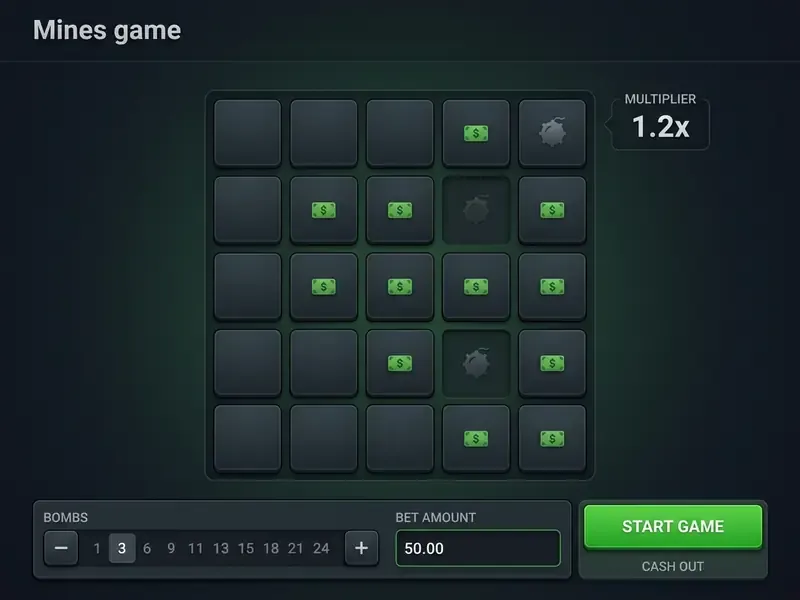
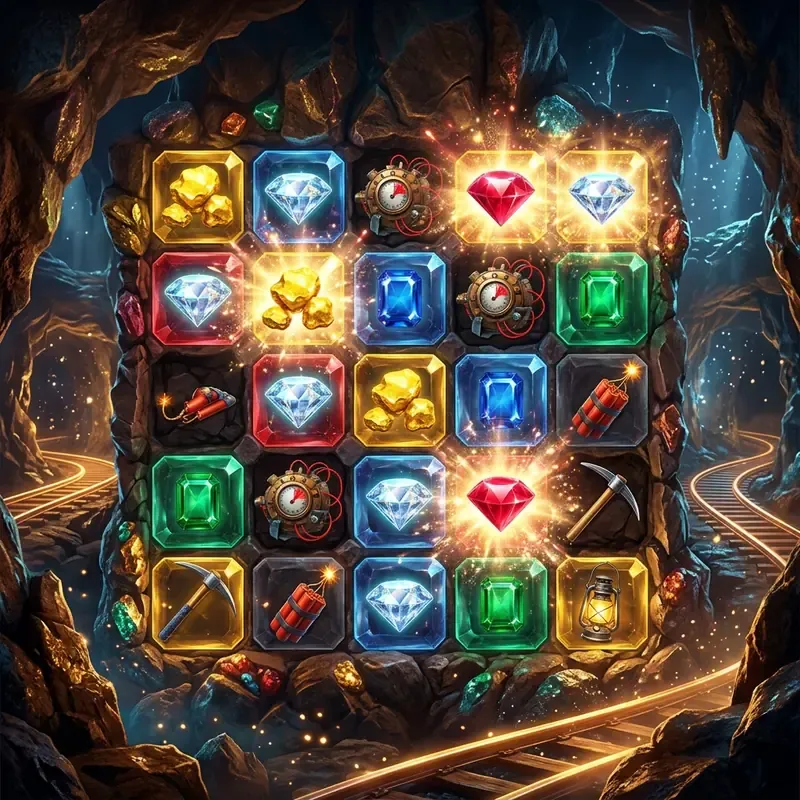
On the 5×5 Spribe layout there are 25 cells. Under each cell sits one of two symbols:

  • The star (or gem/diamond), the profit symbol. Revealing it applies the multiplier shown above the grid to your stake and unlocks the option to stop. Continue, and the next star multiplies the already-multiplied amount.
  • The bomb (mine), the loss symbol. Revealing it ends the round instantly; the stake and all accumulated multipliers for that round are lost.

Because the multiplier climbs in small increments at low bomb counts, players often cash out for amounts barely above their stake. For example, x1.05 on a $10 bet returns $10.50. Fifty cents. That is the whole "win".

Sequences of such micro-gains, interleaved with total losses, resemble what earlier gambling literature described as "losses disguised as wins": outcomes that feel like victories while the balance trends down. Caveat: this effect is documented in pre-2023 slot-machine research and has not, to our knowledge, been tested specifically on Mines-style grid games. It requires verification in the 2023–2026 evidence base before being treated as an established property of this product.

3.2 Grid, Safe Stars, Bombs, and

3.3 Multipliers, Number of Tiles Opened, and Risk-Reward Trade-offs

The core trade-off is simple and unforgiving. Each additional tile you open multiplies your potential return while multiplying the cumulative chance that you have already met a bomb. The probability of surviving k picks is the product of the individual survival probabilities, which decays fast, and decays faster with more bombs on the board.

Preference for high-volatility configurations (10, 15 or 20 bombs, long tile chains) is exactly the pattern that correlates with chasing behaviour and loss of control among problem gamblers.

«A systematic review found high play intensity, loss chasing and credit use to be key risk factors for online gambling.» Baptista et al., systematic review of online gambling risk factors, PubMed/PsycInfo/Scopus, 2010–2020 (published 2024)

Practical consequence: the "exciting" settings and the "risky" settings are the same settings. There is no configuration in Mines that raises expected value. There are only configurations that redistribute the same negative expectation into rarer, larger wins.

4. Probability and Multiplier Tables

Competitor pages frequently publish a single "hit frequency" figure, for instance 51%, as if it described the game. It does not. On a 5×5 grid the chance of a safe first pick ranges from 96% (1 bomb) to 20% (20 bombs). A single number is meaningless without the bomb count.

Probabilities and multipliers, Mines 5×5 (Spribe)

BombsStep 1 (multiplier / cumulative chance)Step 2Step 3
1 bombx1.01 / 96.00%x1.05 / 92.00%x1.10 / 88.00%
3 bombsx1.10 / 88.00%x1.25 / 76.80%x1.43 / 66.52%
5 bombsx1.21 / 80.00%x1.52 / 63.15%x1.93 / 48.91%
10 bombsx1.60 / 60.00%x2.67 / 34.28%x4.67 / 18.26%
15 bombsx2.42 / 40.00%x6.46 / 15.00%x19.39 / 4.80%

Method: cumulative survival probability is calculated as P(S) = (N_safe / N_total) × (N_safe−1)/(N_total−1) × … for each successive pick. Multipliers are rounded illustrative values derived from a 97% RTP paytable; the exact ladder shown in your client may differ slightly by build and operator.

First-pick safety by bomb count (5×5)

BombsSafe tilesChance the first pick is safe
12496%
32288%
52080%
101560%
151040%
20520%
2414%

Two conclusions follow. First, long chains at high bomb counts are lottery-like: a 3-tile run with 15 bombs succeeds roughly once in twenty attempts. Second, low-bomb "safe" play is not free money: at x1.10 per successful round you need a very high win rate to overcome the 3% house edge, and one bomb wipes out roughly ten successful cash-outs.

Run those numbers against a real bankroll before you decide the low-bomb grind is "basically safe". On a $50 session bankroll with $0.50 units, ten clean x1.10 rounds add about 50 cents of profit; a single bomb erases it and then some.

5. How to Play Mines: Step-by-Step Round Guide

5.1 Quick-start in six steps

  1. Set the bet amount. Use the (−) and (+) keys, the coin button with preset values, or the slider. Ranges are operator-specific, typically from $0.20 / R$1.00 up to $1,000 / R$500, with a stated max bet per round.
  2. Choose the number of bombs. In Spribe Mines the selector sits in the upper-right corner and shows the game name plus the current bomb count (1–20). In Hacksaw Mines you also choose the grid size (3×3 to 9×9); presets are 1, 3, 5 and 7 bombs with a custom field.
  3. Press Bet / Play to lock the round. Bomb positions are now fixed for that round.
  4. Open tiles. Click manually, or use the Random opening feature to let the client pick a cell for you.
  5. Watch the multiplier ladder above the grid: it shows your current value and the value of the next successful pick, so the payout for the next step is always known in advance.
  6. Press Cash Out to bank the accumulated amount, or continue. Hitting a bomb ends the round with zero.
5.1 Quick-start in six steps. 1

5.2 Interface controls explained

ControlFunctionPractical note
Bet field / sliderSets stake per roundFix it before the session; avoid "just this once" increases
Bombs selector1–20 (Spribe) / 1–(N−1) (Hacksaw)The single most important risk lever in the game
Grid size3×3 / 5×5 / 7×7 / 9×9 (Hacksaw only)Larger grids: smaller per-tile pay, lower per-tile bomb risk
Cash OutBanks the current multiplierAvailable only after at least one safe reveal
RandomPicks a tile for youUseful for breaking self-invented "patterns"
Auto game / Automatic game modeRepeats a fixed cell selection over N roundsSpeeds up losses as readily as wins; always pair with a stop-loss
How to play / InfoRules, paytable, RTPCheck the RTP here to confirm which build you are on
Provably Fair panelServer seed / client seed / hashSee section 10 for the verification procedure
Sound & music toggleAudio controlTension-building audio is part of the design; muting it is a legitimate self-control tactic
Pros
  • Configurable risk. You set the bomb count, so volatility is under your control.
  • Known next payout. Unlike a spinning reel, the next step's value is displayed before you commit to it.
  • No time pressure. Unlike a rising-curve crash game, there is no countdown; you can pause and think for as long as you like.
  • Simple rules, intuitive controls. The learning curve is minutes, not hours.
Cons
  • Minimalist graphics. Deliberately plain; some players find the look dated.
  • Low multipliers at safe settings. Meaningful multipliers require high bomb counts, which means high risk.
  • High round frequency. The very speed that makes it fun makes bankroll erosion fast.
  • Decision fatigue. Constant cash-out choices are cognitively taxing and encourage rule-breaking late in a session.

5.3 Pros and cons of the format

Advantages Disadvantages

6. Mines Demo Mode and Free Play

6.1 Nature and Purpose of Demo Mode in Mines

The demo game runs the identical client on a virtual balance. There is no deposit, no withdrawal, and typically no registration: load the page, wait for the client, play. If the play-money balance runs out, reloading the game restores it. Its legitimate uses are narrow but real: learning the interface, seeing how the multiplier ladder behaves at 1, 3, 5, 10 and 15 bombs, and testing whether your intended stop rule is something you can actually follow.

Its commercial purpose is different. Free play sits at the top of the acquisition funnel, and the transition from free to paid is frequently engineered rather than accidental.

6.1 Nature and Purpose of Demo

«45.8% of participants played free predictor games; afterwards they were shown personalised real-money betting offers.» Wilson et al., 2023, cross-sectional survey of UK men

Earlier research on social casino games (predominantly pre-2023) described a comparable migration effect, in which a share of free-play users subsequently move to real-money gambling. Updated: we flag this as suggestive rather than settled, because those studies fall outside the verified 2023–2026 source pool used for this article and were not conducted on Mines specifically.

A further caution about mines free play: the client is the same, but the psychology is not. Risk-taking in a play-money environment is typically bolder than with real funds, so a "strategy" that looked profitable across 200 demo rounds may collapse the moment losses are financially real. I have watched testers open eight tiles at 5 bombs in demo and then refuse to open three with $2 on the line. Same math, different nerve.

Earlier research on social casino games

6.2 Differences Between Demo Mode and Real-Money Mines Play

CriterionMines DemoReal-money Mines
PurposePractice, mechanics testingWagering for cash returns
Balance currencyVirtual credits, non-cashReal funds (CAD, USD, EUR, BRL, crypto)
Bet amountFake credits, no exposureReal stake per round, capped by operator max bet
Registration / KYCUsually noneAccount creation and identity verification required
RNG / RTP modelSame underlying math as the live buildSame underlying math
Financial riskNoneFull; deposited funds can be lost
WithdrawalsNot possiblePossible, subject to KYC, limits and processing times
Casino bonusesNot applicableBonuses, free bets, free spins and wagering requirements apply
Behavioural riskLow, but can normalise play and inflate confidenceChasing, session escalation, bankroll damage
Provably Fair checkUsually availableAvailable

Demo mode is a useful tool and a marketing instrument at the same time. Use it deliberately, with a clear intent (test settings, then stop), and with accurate information about what changes when money becomes real. The single biggest change is not the math. It is you.

Moving from demo to real play? Do it with your eyes open. Casino publishes current bonus terms, betting limits and responsible-gambling tools in one place.

7. Accessing Mines Online

7.1 Integration of Mines into Online Casinos, Deposits, and Real-Money Access

To play mines for real money, you need to reach an online casino offering Mines, create an account, and fund it. The usual sequence is:

  1. Registration. Email or phone, password, province, date of birth.
  2. Age and identity verification (KYC). Mandatory at licensed operators, often triggered before the first withdrawal. Have a photo ID and a recent utility or bank statement ready; that is where most Canadian withdrawals stall.
  3. Deposit. In Canada that usually means Interac e-Transfer, Interac Online, a card, an e-wallet such as MuchBetter or ecoPayz, or cryptocurrency at offshore brands. Check the CAD minimum, typically $10 to $20.
  4. Bonus decision. Accept or decline the welcome bonus before funding, since bonus terms may lock your balance behind wagering requirements.
  5. Game launch. Find Mines under "Instant win", "Crash", "Arcade" or a provider filter (Spribe / Hacksaw Gaming).
  6. Withdrawal. Subject to minimum amounts, method restrictions and completed verification. Interac payouts at well-run casinos land in hours; a first withdrawal with pending KYC can take days.

Regulatory basics apply throughout. The operator must hold a valid licence from a relevant gambling regulator: iGaming Ontario under the AGCO for the Ontario market, or an international authority such as the MGA, Kahnawà:ke or Curaçao for offshore brands. The minimum age is 19+ in most provinces and 18+ in Alberta, Manitoba and Quebec. Without a licence, player protections (dispute resolution, segregated funds, verified game math) are not guaranteed.

7.1 Integration of Mines into Online

7.2 Bet Amount Selection, Bomb Count, and Risk Calibration

Two operational choices define your exposure: how much per round and how many bombs. Research on real operator account data shows why the first one deserves particular respect: high bet amounts and high cumulative deposits are significantly associated with gambling problems.

«For online casino players, session length and approved deposit volume were the strongest predictors of self-reported problem gambling.» Auer & Griffiths, 2023, machine-learning analysis of online operator accounts

A workable calibration framework:

  • Unit size:0.5% to 1% of your session bankroll per round. At 1 bomb and x1.05–x1.10 cash-outs, a single bomb erases roughly 10 successful rounds, so unit size must survive streaks, not averages.
  • Bomb count:treat 1–3 bombs as low volatility, 5–7 as medium, 10+ as high, 15–20 as speculative.
  • Session caps:set a hard stop-loss (say 20 units) and a stop-win (say +30%), and close the client when either triggers.
  • Time cap:because round speed is player-controlled, cap minutes as well as money. Session duration is itself a documented risk predictor.
Jojobet heading-banner

One more note on the max bet field. If you are wagering a bonus, the operator's maximum bet per round while wagering usually sits well below the game's own limit. Breach it once and the whole bonus balance can be voided.

8. Real-Money Mines, Casino Bonuses, and Inducements

8.1 Welcome Bonuses, Free Bets, and Complex Wagering Requirements

Welcome offers are the standard on-ramp to real-money Mines: match bonuses, free bets, free spins, cashback. They are also contracts, and many consumers do not fully understand what they have signed.

«Most players misjudge how many times a bonus must be wagered, treating "free" offers as a genuine gift.» Torrance et al., 2026, cross-sectional survey, UK

The gap between perception and contract is where harm accumulates. A "100% up to $500" offer with a 35× wagering requirement on bonus funds obliges you to stake $17,500 in qualifying games before withdrawal, and instant-win titles like Mines often contribute at a reduced rate, or are excluded entirely, precisely because of their low volatility at 1-bomb settings. Maximum bet limits during wagering, commonly a few dollars per round, are another frequent forfeiture trigger.

Read that clause line by line. It is usually one sentence long, and it decides whether your win survives.

Bonuses are not only misunderstood; they demonstrably shape behaviour, and even relatively small bonuses register as triggers for initial gambling.

The gap between perception and contract

«50% of young bettors received a welcome bonus; average importance of the bonus for their first bet was 4.93 out of 10.» Post-COVID observational study of adolescents and young adults, 2023 (n = 24 wagerers)

Longitudinal work on inducements shows the effect is not limited to the first deposit. Odds ratios as high as 4.82 among at-risk gamblers have been reported.

«Bonus use was associated with higher play intensity (β up to 0.57) and increased odds of risky behaviour (OR 1.32–4.82).» Caillon et al., longitudinal study of gambling inducements (addiction journal)

Among younger cohorts surveyed about promotional formats, free-bet offers were perceived as the most influential.

«Young people with gambling problems were more likely to say bonus bets pushed them toward riskier behaviour.» Hing et al., 2024, youth survey on perceptions of wagering inducements

Practical bonus checklist before you claim anything:

  • What is the wagering multiplier, and is it on bonus only or deposit plus bonus?
  • Do instant-win and crash games, including Mines, contribute 100%, a reduced percentage, or 0%?
  • What is the maximum bet per round while wagering?
  • What is the expiry window: 7, 14 or 30 days?
  • Is there a maximum cash-out cap on bonus winnings?
  • Can you decline the bonus and keep a withdrawable cash balance?

8.2 Casino Comparison: Bonuses, Currencies and Wagering

Offers below reflect publicly advertised welcome promotions and change frequently. Always verify current terms on the operator's own page before depositing. The wagering column is indicative and must be read against live T&Cs. Canadian readers should also confirm CAD support, Interac availability and whether the brand accepts players from their province.

#CasinoAdvertised welcome offerCurrenciesWagering (verify in T&Cs)Notes
1BC.GamePackage advertised up to R$3,000,000BRL, USD, EUR, CryptoTiered / task-basedCrypto-first, broad instant-win catalogue
2LeonCasino100% up to R$2,500BRL, EURBonus-based multiplierClassic match bonus
322Bet100% up to 1,600 BRLBRL, USD, EURBonus-based multiplierWide payment rails
4BlazeR$1,272 bonus + 30 free spinsBRLMixed cash/spins termsSpins usually slots-only
5Dafabet100% first deposit up to R$1,400BRL, USDBonus-based multiplierSportsbook plus casino
6Cosmobet150% up to €20 + 50 free spinsEUR, CryptoBonus-based multiplierSmall-stake friendly
7Betano100% up to $500BRL, EURBonus-based multiplierStrong local payment support
820Bet100% up to R$700BRL, EUR, CryptoBonus-based multiplierFrequent reload offers
9F12100% up to R$1,000 on first depositBRLBonus-based multiplierLocal-market focus
10Voodoo100% up to €200 + 50 FSEUR, CryptoBonus-based multiplierSpins restricted by game
11KTOUp to R$200 free bet on first betBRLFree-bet turnover termsFree bet, not cash

How to read this table: a larger headline number is not a better offer. The comparison that matters is (bonus value) ÷ (wagering turnover required), adjusted for whether Mines counts toward that turnover at all. A modest $150 bonus at 20× with instant-win games contributing 100% is worth more, in practice, than a four-figure headline at 45× that excludes the game you actually want to play.

When regulatory protection is weak or an offer is blocked locally, players may turn to unregulated offshore operators.

That is the worst case for a player: no verified game math, no enforceable dispute route, no guaranteed payout, and no age gate.

9. RTP, Risk, and Mines Strategy

Disclaimer. This information is general in nature and does not replace professional advice. Gambling carries a risk of financial loss. Play responsibly and only within the law of your province.

9.1 RTP Information, House Edge, and the Illusion of Control

RTP (return to player) is the theoretical long-run percentage of wagered money returned to players in aggregate. The house edge is its complement:

  • Spribe Mines: RTP 97%, house edge 3%.
  • Hacksaw Gaming Mines: RTP 98%, house edge 2%.

Two clarifications that most pages omit. First, RTP is an average over an enormous number of rounds, not a promise about your session; across 100 rounds, outcomes are dominated by variance. Second, RTP does not change with bomb count. Choosing 1 bomb or 20 bombs alters volatility and the shape of the payout distribution, not the expected return.

Publishing RTP is a transparency measure, and yet players routinely misread the statistic.

9.1 RTP Information, House Edge, and

«Participants shown an "RTP 90%" message rated their chance of winning about five times higher than a no-information group.» Byrne et al., 2025, experimental study, N = 6,062, UK/US (Prolific)

Mines amplifies this misreading because it looks solvable. You see the grid, you know the bomb count, you decide when to stop, and that visible agency creates an illusion of control. In reality the only variable you control is exposure: how much you stake and how many tiles you open before banking.

A fact-check point on a claim repeated by many guides: an RTP said to be "tested over 10,000,000,000 simulations" is a marketing statement unless a named testing laboratory (iTech Labs, eCOGRA, GLI) and a report reference come with it. The defensible formulation is this: the provider declares an RTP of 98% (Hacksaw) or 97% (Spribe), and individual rounds can be independently verified through Provably Fair hashing.

As Reid Calloway, our independent casino analyst voice, puts it: "If a number cannot be traced to a lab report or a game information panel, treat it as advertising."

9.2 Mines Strategies: What They Do and What They Cannot Do

No system changes the house edge. A mines strategy redistributes risk. It changes how often you win, how much you win, and how quickly you can lose your bankroll. Judge them on those terms only.

1. Minimum-risk play (1 bomb, 2–3 tiles)

  • Method: 1 bomb, open 2–3 tiles, cash out.
  • Numbers: about 88% success at three tiles, multiplier around x1.10.
  • Reality check: one loss removes roughly ten wins. Long-run expectation stays at −3%.
  • Best used for: grinding low-variance turnover where instant-win games count toward wagering. Confirm eligibility first.

2. Martingale (doubling after a loss)

  • Method: double the stake after every bombed round to recover with one win.
  • Requirement: a bankroll of at least 100 to 200 base units; a losing run of 7 or 8 rounds needs 128 to 256 units.
  • Failure modes: table maximums cap the doubling sequence, and bankroll depletion arrives faster than most players model. Risk of ruin rises with each step, it does not fall.

3. Fibonacci and D'Alembert (softer progressions)

  • Fibonacci: stakes follow 1, 1, 2, 3, 5, 8 after losses; recovery is slower but drawdowns are shallower than Martingale.
  • D'Alembert: plus one unit after a loss, minus one unit after a win. The gentlest of the three, and correspondingly slower to recover.
  • Reality check: all progressions convert many small wins into occasional catastrophic losses. Expected value is unchanged at −3% (Spribe) or −2% (Hacksaw).

4. Fixed percentage of bankroll (flat or proportional staking)

  • Method: stake a constant 0.5% to 1% of the current bankroll each round.
  • Effect: the most robust bankroll-preservation approach; it automatically reduces stakes during losing runs.
  • Trade-off: no recovery mechanism, and no upside acceleration.

5. Automatic pattern play

  • Method: in automatic game mode, fix a cell selection (for example the four corners at 3 bombs) and run 10 rounds.
  • Value: removes emotional decision-making mid-round and eliminates self-invented "hot tile" habits.
  • Danger: automation multiplies round frequency. Always set a stop-loss and a round limit before starting.

6. Use the Random button deliberately

  • Manual clicking breeds superstition: favourite corners, "cold" rows, avoidance patterns. The random opening feature neutralises those habits. It does not improve odds; it improves honesty about the odds.
9.2 Mines Strategies What They Do

9.3 Gambler's Fallacy: The Error That Costs Most

The gambler's fallacy is the belief that past outcomes influence future ones: that after five bombed rounds a win is "due", or that a tile untouched for ten rounds is safer. In Mines, bomb positions are generated fresh each round. The grid has no memory, and neither do the seeds. Any strategy whose logic depends on a streak "correcting itself" is built on this error.

Its practical form is loss chasing: raising stake size after losses to get back to even. That behaviour, not the game's math, is what turns a 3% edge into a wrecked session.

  1. Provably Fair: Verifying a Mines Round

"Provably Fair" is a cryptographic scheme that lets a player confirm the operator did not alter a round after bets were placed. It replaces trust with arithmetic.

How it works:

  1. The server generates a server seed and publishes its SHA-256 hash before the round.
  2. Your client contributes a client seed, generated in your browser and often editable.
  3. Bomb positions are derived deterministically from server seed plus client seed plus nonce.
  4. After the round, the server reveals the plain server seed.
  5. You hash the revealed seed with SHA-256 and compare it to the hash published in step 1. A match proves the seed was fixed in advance and the layout was not manipulated.

Step-by-step check:

  1. Open the game menu and select Provably Fair / Fairness Settings.
  2. Copy the hashed server seed shown before the round begins, and note your client seed.
  3. After the round, copy the revealed server seed.
  4. Paste it into any independent SHA-256 calculator.
  5. Confirm the output matches the pre-round hash exactly. Then re-run the provider's published derivation to reproduce the bomb layout.

Do it once. Not every round, just once, so you know what the mechanism actually proves.

What Provably Fair does not prove: it does not verify that the paytable delivers the advertised long-run RTP, and it does not make the game profitable. It proves round integrity, nothing more. For RTP assurance, look for a licensing authority and an independent test-lab report.

10. Provably Fair Verifying a Mines

11. Mines Mobile and Download: Phone or Browser

11.1 Browser-Based Play Versus App Download

Mines is an HTML5 product, so it runs in mobile browsers on Android and iOS without installation, and most regulated casinos serve Mines online in browser mode with no download at all. Full-screen mode is typically supported, and progress and balance live on the operator's server rather than on the device.

Browser (HTML5)Native casino appThird-party .APK
Install requiredNoYes (official store)Yes (sideload)
Storage useNoneModerateModerate
Update pathAutomatic server-sideStore updatesManual, unverified
Permissions grantedBrowser onlyApp permissionsApp permissions plus "install unknown apps"
Security postureHighest for casual playGood, store-reviewedHigh risk

11.2 When a Mines Download Is Not Needed

For most players, it never is. If you can load the casino lobby in Chrome or Safari, you can play the game in both demo mode and real-money mode on the same phone, with the same account and the same CAD balance. A mines download only makes sense when the operator ships a genuine store-listed app with extras such as biometric login, faster deposits or push-based limit reminders. Even then, the game itself is the same HTML5 build.

11.3 The Risk of Sideloaded .APK Files

Installing an APK from a forum, messenger link or mirror site bypasses store review. Android treats "install unknown apps" as a distinct permission precisely because that path is a documented malware vector: packages can be repackaged with malicious code, enabling credential theft, ad fraud or broader device abuse, and Google Play Protect's store-mediated checks do not apply in the same way to files obtained outside the store. If a casino genuinely offers an app, install it from the official store or the operator's verified site, never from a third-party aggregator.

11.4 Smartphone Access and Its Impact on Gambling Behaviour

Mobile access is convenient, and that convenience is the risk. It is associated with higher participation, greater frequency, higher spend, more impulsive bets and reduced ability to disengage.

«The smartphone creates instant access anywhere, prompting spontaneous bets, loss chasing and betting under social pressure.» Hing et al., 2024, qualitative grounded-theory study of young adults

Device type and wagering frequency are statistically linked to harm.

«Among sports bettors, daily bet count and smartphone use were key predictors of self-reported problem gambling.» Auer & Griffiths, 2023, machine-learning analysis of online operator accounts

Practical mobile hygiene for Mines players: disable one-tap deposits and stored card details, turn off push notifications from casino apps, set operator-side deposit and loss limits before a session, use device screen-time limits, and never play while commuting, drinking or in an emotional state. Those are the settings most associated with impulsive rounds.

  1. Pre-Session Checklist

  • Have I confirmed which version is loaded: Spribe 5×5 at 97% RTP, or Hacksaw Gaming with selectable grid at 98%?
  • Have I checked the RTP figure in the in-game info panel for this specific build?
  • Have I set a hard stop-loss and a stop-win for this session, in money and in minutes?
  • Have I tested my chosen bomb count in demo mode and confirmed the multiplier ladder?
  • Is my unit stake 1% or less of my session bankroll?
  • Have I verified the casino's licence (iGaming Ontario / MGA / Kahnawà:ke / Curaçao) on the regulator's register?
  • Have I confirmed CAD support and Interac withdrawal times, plus the minimum payout amount?
  • If I claimed a bonus: do instant-win games count toward wagering, and what is the max bet per round?
  • Have I recorded the pre-round Provably Fair hash if I intend to verify a round?
  • Have I disabled one-tap deposits and casino push notifications on my phone?
  • Am I playing with money I can afford to lose, and not with borrowed funds?
12. Pre-Session Checklist. - Have I

  1. FAQ: Mines Demo, Real Money, Odds and Mobile

  1. Conclusion

Mines is a fast, transparent-looking and genuinely engaging instant-win product whose appeal rests on one design trick: it hands the player a visible grid and a cash-out button, so it feels like a game of judgement. Structurally it is nothing of the kind. Bomb positions are fixed before the first click, every round is independent, and the declared RTP of 97% (Spribe) or 98% (Hacksaw Gaming) sets a long-run house edge of 2% to 3% that no bomb count, click pattern or staking progression can move. Player-controlled speed, low-value "wins" that feel like victories, mobile availability and bonus-driven acquisition together make this a product that deserves careful oversight, even while its specific mechanics remain under-studied.

14. Conclusion. Mines is a fast

Play Mines on a licensed platform: Casino publishes verified RTP figures, self-exclusion tools and transparent bonus terms in plain English.

What the evidence base supports is modest and practical. RTP disclosure is widely misread, and players who see it overestimate their chances. Bonuses are systematically misunderstood and are linked to greater play intensity and higher odds of risky behaviour, especially among younger players. Free play feeds real-money conversion through personalised offers. Smartphone access raises frequency, impulsivity and spend. Session length and deposit volume are among the strongest observable predictors of gambling problems. Weak regulatory protection pushes players toward offshore sites where neither age checks nor game integrity is guaranteed.

Used deliberately, with the demo first, the licence verified, the unit stake capped at 1%, a stop-loss and a time limit set in advance, and the Provably Fair hash checked once so you understand the mechanism, Mines is entertainment with a known and modest cost. Used as an income strategy, it is a 2% to 3% headwind compounded by every extra round you play.

Compare on the facts, read the terms before you deposit, and play responsibly. 19+.

What the evidence base supports is

  1. Appendix A: Corrections and Unverified Claims

For transparency, the following statements were revised, qualified or flagged during editing rather than silently deleted:

  1. "Predefined RTP." The original phrasing implied RTP is an intrinsic property of the game. Corrected: RTP is a figure declared by the provider for a specific build, realised only over very large numbers of rounds, and best confirmed against the operator's licensing documentation.
  2. "More bombs increase volatility and multiplier." Retained, but labelled as a mathematical extrapolation from the game's stated configuration rather than an empirical research finding.
  3. "Losses disguised as wins" in Mines. Retained as a plausible mechanism, with the caveat that the supporting literature predates 2023 and was conducted on slot machines, not grid instant-win games. Verification in the 2023–2026 evidence base is required.
  4. Social-casino "migration effect." Retained as suggestive; the source studies fall outside the verified 2023–2026 pool used here and were not conducted on Mines.
  5. "RTP tested over 10,000,000,000 simulations" (claim circulating on competing pages). Not adopted: no named testing laboratory or report reference is available. Replaced with the provider-declared RTP plus Provably Fair verification.
  6. "Hit frequency 51%" (claim circulating on competing pages). Rejected as a false generalisation: first-pick safety ranges from 96% (1 bomb) to 20% (20 bombs) on a 5×5 grid. Replaced with full probability tables.
  7. Release dates. Hacksaw Gaming Mines: 3 March 2022 (supported). Spribe Mines: 2021 (provider portfolio); exact launch notes are version-specific and not uniformly published.
  8. Maximum win. The x10,000 multiplier cap is supported for Hacksaw Gaming; Spribe's ceiling is expressed as a cash cap. The two are not interchangeable.
  9. Bonus table figures. Advertised welcome offers change frequently and wagering values are indicative only. Live operator T&Cs prevail, and CAD availability must be confirmed per province.

Referenced research (as supplied to the editorial team): Byrne et al. (2025), experimental study on RTP messaging, N = 6,062, UK/US, Prolific · Torrance et al. (2026), cross-sectional survey on bonus comprehension, UK · Post-COVID observational study of adolescents and young adults (2023), n = 24 wagerers · Caillon et al., longitudinal study of gambling inducements · Hing et al. (2024), youth perceptions of wagering inducements · Hing et al. (2024), qualitative grounded-theory study of smartphone gambling · Auer & Griffiths (2023), machine-learning analysis of online operator account data · Wilson et al. (2023), cross-sectional survey of UK men on free predictor games · Baptista et al. (2024), systematic review of online gambling risk factors (PubMed/PsycInfo/Scopus, 2010–2020) · Choi (2024), SEM analysis of offshore gambling site use, US. Provider parameters: Spribe and Hacksaw Gaming official game information panels. Mobile security guidance: Android Developers (2024), Google Play Protect documentation (2024), NIST mobile security guidance (2023), CISA advisories (2024).

Final reminder: 19+, or 18+ in Alberta, Manitoba and Quebec. This article is informational and does not constitute financial, legal or medical advice. Gambling involves a risk of financial loss, so play responsibly, use deposit and loss limits, and contact a provincial gambling support service if play stops feeling like a choice.

15. Appendix A Corrections and Unverified