Plinko: How to Play Online Free and for Real Money (Demo, RTP, Providers and Risk Maths)

Last updated: January 2026 · Prepared by: the editorial team behind our iGaming research hub · Audience: 19+ in Canada (18+ in some jurisdictions)

Quick summary. Plinko is a vertical-drop, instant-win casino game. A ball falls through a staggered pyramid of pegs and settles into a bottom pocket carrying a multiplier. The player controls only three inputs: stake size, number of rows (usually 8 to 16), and risk level (Low / Medium / High). The landing slot itself comes from a certified random number generator (RNG) or from a provably fair seed pair. Published RTP runs from roughly 96% to 99% depending on the studio: 99% for BGaming's Plinko, up to 98.98% for Hacksaw Gaming's version. Maximum multipliers span x1,000 (BGaming) to x3,847.3 (Hacksaw). The probability of hitting a single outermost pocket on a 16-row board is 1 in 32,768.

Provider

Hacksaw Gaming

RTP

98.98%

Volatility

High

Max win

3,843.3x

Plinko How to Play Online Free

Why This Matters Before You Deposit

Here is the reader's real question: can I try Plinko free, and what changes when I switch to real money in CAD?

Short answer. Quite a lot changes, but not the board.

The demo and the cash version usually share the same paytable and the same maths. What appears in cash mode is everything around the game: a licence, a payout queue, a wagering table that may exclude Plinko entirely, and a withdrawal that can stall on verification. That gap between "fun board" and "funded account" is where most complaints start.

In Canada the context is specific. You are playing in Canadian dollars, most likely funding through Interac e-Transfer or an e-wallet, and you are 19+ in every province except Alberta, Manitoba and Quebec, where 18 applies. Provincial bodies such as the Alcohol and Gaming Commission of Ontario, along with iGaming Ontario for the regulated Ontario market, set the rules that actually protect you. Offshore brands licensed in Malta or Curaçao serve Canadians too, but the enforcement behind those licences is not equal. We will come back to that.

One more framing note. This guide is not a pitch. It is a checklist you can run yourself before the first deposit, plus the mathematics that explains why no Plinko strategy beats the house edge.

Why This Matters Before You Deposit

1. Plinko as an Online Casino Game

Plinko sits awkwardly in modern casino catalogues. It is not a slot in the classic reel sense, and it is not a table game. A round resolves in two to four seconds. Nearly every major studio now publishes at least one interpretation of the format, and any operator marketing a "complete" library is expected to carry it.

1.1 From Television Game Show Mechanic to Online Instant-Win Product

The gambling adaptation keeps the visual metaphor intact: a ball or disc falling through a pyramid of pegs. Most online casino lobbies file it under "Casual", "Instant Win", or "Crash & Originals" rather than under slots. What changed in the move from a physical board to software is the source of randomness. Gravity and peg tolerances were replaced by a mathematical result computed server-side.

The commercial appeal is straightforward. There is no paytable to memorise, no bonus round to trigger, no free-spin mechanic to learn. One tap sends the ball down, and the outcome is visible immediately. That immediacy, the same loop that powers Mines, Dice and Crash, is precisely why regulators treat fast-cycle instant-win products as a distinct risk category.

Worth saying plainly: speed is the product. Everything else is presentation.

1.1 From Television Game Show Mechanic

1.2 Board Structure: Rows, Pegs, and Multiplier Pockets

A Plinko board has four visual components:
  • Drop point -a single release node above the peg field, usually top-centre.
  • Peg pyramid (rows) -a staggered triangular lattice; each row adds one potential left/right deflection.
  • Trajectory -the descending zig-zag produced by successive peg collisions.
  • Payout row -the bottom band of pockets, each labelled with a multiplier.
1.2 Board Structure Rows, Pegs, and

Row count is the geometric driver. An 8-row board offers 9 landing pockets and 2⁸ = 256 possible left/right paths. A 16-row board offers 17 pockets and 2¹⁶ = 65,536 paths. Because the number of distinct paths leading to each pocket follows the binomial coefficients, the centre pockets are reachable by tens of thousands of routes while each outer pocket is reachable by exactly one. That is why central pockets carry sub-1x values and the extremes carry the headline multipliers.

RowsPocketsTotal pathsPaths to a single edge pocketProbability of one specific edge pocket
8925611 in 256
12134,09611 in 4,096
141516,38411 in 16,384
161765,53611 in 32,768 (either edge combined: 1 in 32,768)

The widely quoted "odds of winning the max are about 1 in 32,768" refers specifically to a 16-row configuration, where the two symmetrical corner pockets together account for 2 of 65,536 possible paths.

1.3 Instant-Win Classification, RNG, and Certification

Plinko's classification as an instant-win RNG game carries both regulatory and psychological weight. On the regulatory side, the result is generated by software that must be tested by an accredited laboratory, and the return-to-player figure is a fixed mathematical property of the paytable rather than a dial an operator can turn at will. On the psychological side, the animation is a presentation layer. The ball is rendered along a path consistent with an outcome that already exists.

So any sense that careful placement of the ball, precise timing of the drop, or a streak-based wagering pattern can influence the landing slot reflects an illusion of control rather than genuine skill.

1.3 Instant-Win Classification, RNG, and Certification

"Participants who saw more wins early in a sequence rated their ability to predict outcomes higher than those who encountered losses, even in a fully random task." - Eben et al., online replication of Langer & Roth's illusion-of-control research (2023)

That finding matters here because early-session variance is high. A run of three or four mid-value pockets in the first minute is entirely ordinary, and it is exactly the sequence that inflates confidence in a setting where confidence has no predictive value.

2. Origins: From The Price Is Right to the Galton Board

2.1 The 1983 Television Debut

Plinko was introduced as a pricing game on The Price Is Right in 1983. The name itself comes from the "plink-plink-plink" of the chip striking pegs on the way down. Contestants dropped flat discs from the top of a large vertical board into cash slots at the base. The format's staying power rests on one design property: the audience sees the entire probability space at once, and every bounce is a visible micro-drama.

2.2 The Galton Board and Japanese Pachinko

Mechanically, the television game is a themed adaptation of the Galton board (or bean machine), a nineteenth-century pin-and-slot apparatus built to show how repeated independent binary deflections produce a normal-shaped distribution across bottom bins. The connection is not decorative. It is the reason Plinko's payout structure looks the way it does.

A second lineage runs through pachinko, the Japanese arcade format in which small metal balls are propelled into a pin field and settle into scoring pockets. Several online interpretations, including Hacksaw Gaming's release, lean explicitly on that pachinko aesthetic. Sources do not really disagree on origin: the TV game, the Galton board and pachinko share the same peg-deflection principle, expressed for three different purposes - entertainment, statistical demonstration, and gambling.

2.2 The Galton Board and Japanese

2.3 Why the Ball Cannot Be Steered

In a provably fair implementation, the outcome is fixed before the animation begins. A server seed (hashed and published in advance), a client seed and a nonce are combined and hashed. The resulting byte stream maps to a sequence of left/right decisions. The player cannot see, adjust or interrupt that computation mid-round.

This is where one widely repeated claim needs correcting. Casual browser simulators sometimes state that "drop position matters" and that different release points bias results. Updated: on physical boards, and in some non-monetary physics simulators, release position genuinely alters the trajectory distribution. In commercial RNG or provably fair casino builds, the drop point is decoration. The landing pocket is derived mathematically, and no release choice changes expected value (EV). Treating drop position as a lever in a real-money game is a category error.

Here is what that means for you: nothing you click before the ball falls improves the odds. Only your stake size and your stop rule are genuinely under your control.

2.3 Why the Ball Cannot Be

3. Plinko Demo: How to Play Free Before You Stake

3.1 Availability and Structure of Plinko Demo Versions

Almost every studio publishing Plinko also publishes a free demo. The demo runs the same board logic and the same paytable as the cash version, but stakes come from a virtual credit balance, so no deposit is required and no withdrawal is possible. BGaming states plainly that its demo lets players "test different risk levels, row counts, and bet sizes without spending real money."

Published demo RTP normally mirrors the real-money figure: 99% for BGaming's Plinko, up to 98.98% for Hacksaw's. Some third-party trackers have cited slightly lower per-risk-level numbers for certain titles, for example 98.60% for Plinko 2. Data note: we have not been able to trace that 98.60% figure to a named testing laboratory or provider datasheet, so treat it as unverified until the studio or operator publishes a per-configuration table.

What free Plinko is genuinely useful for:

  1. Interface familiarisation - locating the risk selector, row selector, bet field, autoplay panel and fairness tab.
  2. Volatility calibration - watching the multiplier band narrow or widen as you move between Low, Medium and High.
  3. Row experimentation - seeing how an 8-row board produces frequent mid-range hits while a 16-row board concentrates value at the extremes.
  4. Autoplay behaviour - checking stop conditions, loss limits, and single-ball versus serial-ball launch.
  5. Session-pacing awareness - counting how many rounds you actually complete in ten minutes at turbo speed.

What a demo cannot do is train a winning method, because there is nothing to train. It also carries one specific hazard: some demo implementations, especially for slots, use exaggerated return rates that can foster unrealistic expectations before a player switches to cash mode.

3.1 Availability and Structure of Plinko

3.2 What You Can Check in the Free Version of Plinko

Think of the free version as a settings lab rather than a rehearsal for winning. Four things are worth testing deliberately.

Risk level against your patience. Set High risk, 16 rows, and run 50 drops. Count how many pockets paid under 1x. Most players are surprised by the answer, and that surprise is cheaper in demo credits than in Canadian dollars.

Row count against hit frequency. Drop to 8 rows at the same risk band. The multiplier ceiling falls, the mid-range hits arrive more often, and the balance curve looks noticeably calmer.

Multiplier table visibility. Every legitimate build displays the full pocket-by-pocket table on screen. If a version hides it or shows values that do not match the studio's own catalogue page, close the tab. That is an originality check, not paranoia.

Interface features that affect pace. Turbo toggle, autoplay round counter, stop-on-loss field, record table. These features determine how fast money moves, which matters more than any multiplier.

3.2 What You Can Check in

3.3 Plinko Online Without Download and on Mobile

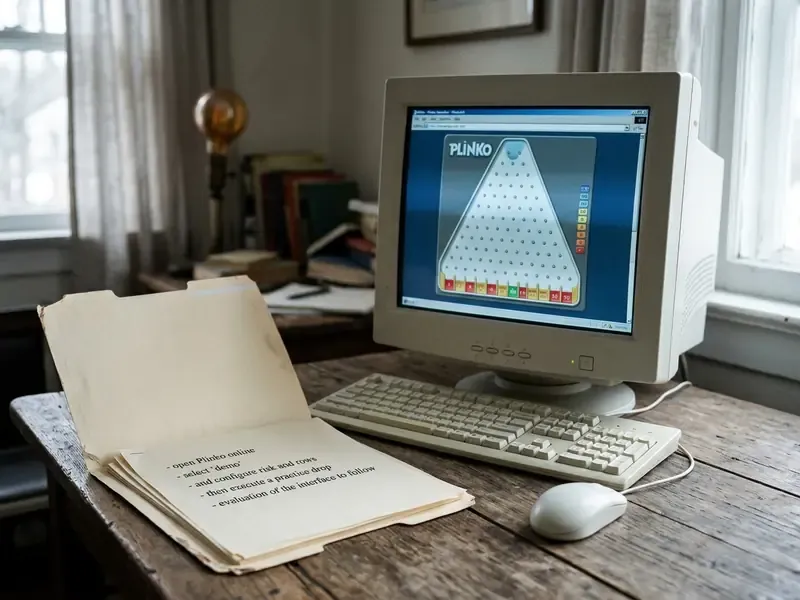
No plinko download is required for the mainstream builds. Modern Plinko is delivered as an HTML5 web application, so the same codebase runs in Chrome, Safari, Firefox and Edge, on desktop, tablet and phone. You open a URL, the game loads, and that is the whole install process.

Plinko mobile deserves a specific note. Because rounds resolve in seconds, mobile performance is not a cosmetic issue. Look for three things: load time under a few seconds on cellular data, animation that does not stutter mid-drop, and controls that fit a small screen without accidental taps on the bet field. Poor optimisation breaks the pacing the format depends on, and a mistap on stake size costs real money.

Some studios also distribute native apps, and a handful of Canadian-facing operators publish their own casino app. Browser play remains the default, and it offers the same board, the same risk settings and the same paytable. No installation, no APK sideloading, no extra permissions.

3.3 Plinko Online Without Download and

3.4 Experimental Evidence on Demo-Mode Return Rates and Beliefs

The concern above is not speculative. An audit of online gambling sites by Sévigny and colleagues found that a substantial share of trial modes did not reproduce real-money mathematics: 39% of the sampled sites offered demo slots with return rates over 100%, with some trial modes exhibiting return rates around 185%. Data note: we cite this as reported in secondary summaries. Readers who need the primary dataset should consult the original Sévigny et al. publication, since the underlying sample and sampling period are not restated in the sources available to us.

A later quasi-experimental study tested the psychological consequence directly. Researchers built two versions of the same slot, one with a realistic return rate and one inflated to 180%, then measured belief change. Seventy college students were randomly assigned to one of the two conditions and played the slot in a trial mode that mimicked online casino demos.

3.4 Experimental Evidence on Demo-Mode Return

"Exposure to an exaggerated 180% return rate significantly increased participants' confidence in favourable outcomes and strengthened irrational beliefs about their chances of success." - Lalande, Emond & Bélanger, quasi-experimental study of online slot demo modes (2022)

A technical critique of demo slots describes how a 2023 rollout of a popular slot with a 96.1% real-money RTP presented a demo that stripped away the gamble-feature volatility and effectively flattered the player. Reformulated for transparency: that specific rollout example circulates in industry commentary without a clearly attributed publisher or author in the sources available to us, so we present it as an illustrative industry report rather than verified data. The underlying and well-supported point stands: a demo is only a valid rehearsal if its mathematics match the cash game.

For Plinko specifically the risk is lower than for feature-heavy slots. There is no bonus round to remove, and the paytable sits on screen. The verification step is still the same: compare the RTP shown in the demo's info panel against the studio's published datasheet before switching modes.

A technical critique of demo slots

3.5 Free-Practice Checklist Before Your First Cash Round

  • Open the game info panel and record the stated RTP and max multiplier.
  • Confirm the provider name in the info panel matches the lobby listing (originality check).
  • Run 50 rounds at Low / 16 rows and note the balance curve.
  • Run 50 rounds at High / 16 rows and note the depth of the worst drawdown.
  • Run 50 rounds at High / 8 rows to feel the difference row count makes.
  • Test autoplay with an explicit stop-on-loss value.
  • Locate the fairness/verification tab and read the seed disclosure.
  • Decide, in writing, the stake and loss limit you will use in cash mode.
- Open the game info panel

4. Where to Play Plinko for Real Money

4.1 Licensing, Regulation, and RNG Testing

Real-money Plinko belongs only at an operator with a verifiable licence. For Canadians there are effectively two routes.

Provincially regulated. In Ontario, private operators run under the Alcohol and Gaming Commission of Ontario and contract with iGaming Ontario. Elsewhere, provincial lottery corporations such as BCLC's PlayNow, Loto-Québec, ALC and Play Alberta operate their own platforms. Game selection is narrower, but dispute resolution sits with a body that answers to the province.

Offshore licensed. In this niche the two most common jurisdictions are the Malta Gaming Authority (MGA) and Curaçao. MGA licensees operate under AML/CFT obligations, mandatory responsible-gaming measures and continuing supervisory compliance. Curaçao-licensed brands operate through a master-licence and sub-licence structure where oversight is weaker and varies by licence holder. The difference is regulator enforcement, not the game itself.

On the supply side, studios hold B2B licences of their own. BGaming's corporate entity, Stable Games Ltd, is registered in Valletta, Malta and licensed by the MGA under a B2B Critical Gaming Supply Licence (MGA/B2B/785/2020, issued 18 March 2021). That is the kind of documentation that should be publicly traceable for any provider whose game takes your money.

Certification of the randomness itself sits with independent test houses such as eCOGRA and iTech Labs. eCOGRA describes its core function as verifying that random number generators produce genuinely unpredictable outcomes.

4.1 Licensing, Regulation, and RNG Testing

"eCOGRA's testing methodology covers source-code review, statistical analysis of output distributions, assessment of seeding methods, and periodic re-audits." - eCOGRA RNG certification documentation

Verification limitation, stated openly: we could not retrieve a public iTech Labs or eCOGRA certificate naming Plinko specifically and confirming the 98-99% RTP band. The RTP figures in this article are those published by the studios (BGaming: 99%; Hacksaw Gaming: up to 98.98%). Treat them as vendor-published rather than lab-confirmed until a certificate appears. No data is better than a comfortable guess.

4.2 How to Choose a Plinko Casino: Licence, Provider and Fair Play

Four checks, in order, before you deposit.

  1. Licence and legality in your province. Find the licence number in the site footer, then verify it on the regulator's own register rather than trusting the badge image. Confirm the brand accepts players from your province and states the correct age gate, 19+ in most of Canada.
  2. Payout speed and limits in CAD. Look for Interac e-Transfer withdrawals, stated processing windows, per-transaction and monthly caps, and whether the operator charges a fee. A casino that publishes real limits is telling you something useful; one that publishes nothing is also telling you something.
  3. Provider integrity and game originality. The lobby should name the studio (BGaming, Hacksaw Gaming, Betsoft, SmartSoft) and the in-game info panel should match it, RTP included.
  4. Bonus fairness. Wagering multiple, max cashout, bet cap while wagering, and the game-contribution table. That last one decides whether Plinko counts at all.

Then read the terms line by line. Tedious, yes. Cheaper than a cancelled withdrawal.

4.2 How to Choose a Plinko

4.3 Provider and Version Comparison

Plinko's simple loop has spawned dozens of derivatives; one aggregator lists well over 100 free Plinko-style titles. The table below covers the versions that matter commercially. Figures are as published by the studios or by operator game pages, and where a value is approximate or operator-dependent it is marked as such.

ProviderVersionRTPMax multiplierRows / linesDistinctive feature
BGamingPlinko (released 28 Jan 2019)99.0%x1,0008-16Three risk levels, Manual/Auto modes, on-screen record table, live RTP insights
Hacksaw GamingPlinko (released 2019)up to 98.98%x3,847.3adjustablePachinko theme, multiplier band 0.3x-3,847.3x, max win capped in currency (e.g. C$100,000)
BlitzcrownLollypop Plinko / Double Pop Plinko~96% (operator-dependent)x5,000+fixed by buildSpring Slots relaunch the ball to the top and multiply it by four on each re-entry
BetsoftPlinko Rush~96.5% (operator-dependent)x1,0008-16Fast, adjustable-volatility board tuned for longer sessions
BetsoftOlympus Plinko~97% (operator-dependent)Progressive jackpotfixed by buildPrize wheel with instant cash, multiplier boosts and jackpot entries; counter unlocks extra spins
DragonGamingPlinko Blitzoperator-dependentoperator-dependentfixed by buildRandom multiplier balls plus a "dead zone" pocket that increases downside
SmartSoftPlinkoXoperator-dependentoperator-dependentadjustableMultiplayer-style presentation with shared rounds
Gaming CorpsPlinko 5000operator-dependenthigh-bandadjustableHigh-ceiling board aimed at max-win hunting

Reading the table: the "99% RTP" figure that circulates online belongs specifically to BGaming's build. Hacksaw sits marginally below it. Third-party and themed variants, especially those bolting on wheels, jackpots or relaunch mechanics, generally land in the 96-97% band, because the cost of the extra feature has to be funded from the return. A jackpot version is not a better version. It is a differently distributed version.

4.4 Deposits, Withdrawals, Bonuses, and Wagering

Most crash-and-instant-win platforms lean heavily on cryptocurrency, though Interac e-Transfer, cards and e-wallets are standard at MGA-licensed brands serving Canada.

StepDepositWithdrawal
1Open the cashier and choose Interac e-Transfer, card, e-wallet, or copy the casino wallet address (BTC, ETH, LTC, SOL)Complete KYC verification if not already done
2Send funds from your bank, wallet or authorise the card paymentEnter your Interac email, bank details or personal wallet address
3Wait for confirmation (minutes for Interac and most chains)Submit the request; note that a network or processing fee may be deducted
4Balance credits in CAD; the game becomes available in cash modeWait for operator approval and network or bank settlement
5Set deposit and loss limits before the first roundConfirm receipt in your own account or wallet

A practical note on verification. Most stalled withdrawals in this niche are not refusals; they are documents. Upload ID and proof of address the day you register, before you have a balance worth arguing about, and the first cashout usually moves at the speed the operator advertises.

On bonuses, keep expectations modest. Plinko is a high-speed, high-RTP RNG product, which is exactly the profile operators restrict. In practice:

  • Plinko is frequently excluded from welcome-bonus wagering, or contributes at a reduced rate, sometimes 0%, under the game-contribution table.
  • Welcome packages are usually tied to turnover multiples of deposit plus bonus. Cashback may arrive as cash or as a bonus with separate wagering terms.
  • Bet caps while wagering and withdrawal limits are operator-specific and vary by jurisdiction, account tier and bonus status. There is no universal Plinko limit.
  • Some brands run wager-free drops, cashback or seasonal promotions that do accept Plinko. Those are the ones whose terms are worth your ten minutes.

Always check the game-contribution table before assuming a bonus can be cleared on Plinko. A 99% RTP game contributing 5% to wagering is, in effect, an expensive way to clear a bonus.

A practical note on verification. Most

5. How to Play Plinko Online: Setting Your Bet and Launching a Round

5.1 A Round, Step by Step

  1. Open the game in demo or cash mode and read the info panel: RTP, max multiplier, min and max bet.
  2. Enter the stake. Typical ranges start around 1 unit and run to 100 units per ball, though limits are operator-set.
  3. Choose the row count, 8 to 16 in BGaming's build. Other studios expose the same range or a narrower one.
  4. Choose the risk level: Low, Medium (Normal) or High. This selects the multiplier table.
  5. Choose the launch mode: Manual (one ball per click) or Auto (serial launch, hands-off).
  6. Press Bet / Play. The ball drops through the pyramid.
  7. Collect. The landing pocket's multiplier is applied to the stake and credited instantly. A losing pocket, anything below 1x, returns only a fraction of the stake.
  8. Review the record table. Most builds log recent results. Use it to audit your own session length and stake creep, not to forecast the next drop.

The three parameters interact in a way worth stating precisely: stake size never changes the multiplier table. It scales the cash outcome linearly. Only risk level and row count change the distribution.

5.1 A Round, Step by Step

5.2 Bet Size, Rows and Risk Level: How the Settings Interact

Three dials, one outcome distribution. Here is how they relate.

Bet size is pure scaling. A C$1 ball landing on 0.5x returns 50 cents; a C$10 ball on the same pocket returns C$5. Nothing about the board changes. What changes is how quickly your bankroll meets variance, which is why stake as a percentage of bankroll matters more than the absolute number.

Rows set the resolution of the board. More rows mean more pockets, a taller extreme, and a sharper concentration of probability in the middle. Sixteen rows with High risk gives you the biggest max multiplier available in most builds, and the longest stretches of sub-1x results on the way there.

Risk level redistributes a fixed RTP. Low keeps most pockets close to 1x. High hollows out the middle and loads the edges. Same theoretical return, wildly different session shape.

One practical rule from testing sessions: pick the risk level first, then size the stake to survive at least 100 rounds at that setting. Reversing the order is how small bankrolls end early.

5.2 Bet Size, Rows and Risk

5.3 Launching the Ball, Autoplay and Checking Your Win

Manual launch means one press of BET, one drop, one result. Autoplay hands the launching to the software for a set number of rounds, with optional stop conditions on loss, win or balance.

Autoplay is the single most consequential setting in the interface, because it removes the decision point between rounds. An interrupted time-series analysis of autoplay in online slots quantified the effect: use of auto-play increased total stake amount by roughly 7-9%.

"Autoplay use increased total stake volume by roughly 7-9% and spin counts by about 3%, while players' net losses did not change significantly." - Jonsson, Carlbring & Lindner, interrupted time-series study of autoplay in online slots (2024)

The nuance matters. Autoplay did not make players lose meaningfully more per session in that dataset. It made them wager more and play faster. For a 99% RTP game, higher turnover at unchanged RTP still means higher expected cost over time, and less deliberation about when to stop.

Before you start a serial run, set three things: number of rounds, stop-on-loss in CAD, and stop-on-single-win if the build offers it. Then check the balance against the record table when the sequence ends, rather than mid-run. Watching every drop while autoplay works is the worst of both worlds.

5.4 Game Design Changes and Play Intensity

The UKGC evaluation cited in section 4.5 is the closest thing this industry has to a controlled test of pace restrictions, and its direction of travel matches the autoplay findings. Slow the loop, and both session length and stake size fall. Applied to Plinko, three practical levers exist even where regulation does not force them:

  • Turn turbo mode off. Turbo compresses the animation and can double or triple rounds per minute.
  • Use manual launch rather than serial launch for at least part of the session, so each stake is a conscious act.
  • Set an autoplay stop-loss rather than a round count, so the session ends on a financial condition instead of an arbitrary counter.
5.4 Game Design Changes and Play

5.5 Volatility, Winning Streaks, and Session Outcomes

High-variance settings do not merely raise the ceiling. They reshape the whole session. A 2023 study on video poker volatility, for instance, reported that increased volatility results in more winning players but shorter winning streaks.

"Increased volatility produced a greater number of winning players but shorter winning streaks, indicating more frequent sharp reversals in outcomes." - Study on video poker volatility (2023)

Translated into Plinko terms: on High / 16 rows, a session is a long series of 0.2x-0.5x returns punctuated by occasional spikes. You may end a short session ahead more often than intuition suggests, but the path is jagged, and the drawdowns between spikes run deep enough to exhaust a small balance before any spike arrives.

6. RTP, Volatility and Risk in Plinko

6.1 What the RTP Figure Does and Does Not Mean

RTP is the proportion of total stakes returned to players over a very large number of rounds. Plinko's headline figures are unusually high for a casino product: 99% (BGaming), up to 98.98% (Hacksaw), roughly 96-97% for feature-heavy third-party variants. A 99% RTP implies a theoretical house edge of 1% per unit wagered.

Two caveats belong immediately alongside that number.

  1. RTP is a long-run average, not a session guarantee. Over 200 rounds, realised return can land anywhere across a wide band.
  2. RTP says nothing about variance. Two configurations with identical RTP can produce completely different session experiences. Expected value is the same; risk of ruin is not.
6.1 What the RTP Figure Does

6.2 Risk Levels and Multiplier Spread

At a fixed RTP, the risk selector redistributes the same expected return across a wider or narrower set of pockets. The table below reflects commonly published paytables. Exact values vary by provider, build and operator, so verify in the game's own info panel.

RowsRiskApprox. minimum multiplierApprox. maximum multiplierPayout distribution character
8Low~0.3x~8xFrequent small returns, shallow drawdowns
8Medium~0.2x~15xBalanced; moderate swings
8High~0.1x~130xRare large hits, long dry runs
11Low~0.4x~28xVery smooth curve; long sessions
16Low~0.5x~2x-16x (build-dependent)Narrowest spread; minimal balance erosion per round
16Medium~0.2x~12xMiddle path; occasional meaningful spikes
16High~0.1x~1,000xExtreme concentration at the edges; 1 in 32,768 for a corner pocket

A concrete illustration of how the two settings compound: on Low risk with 11 rows, the maximum win available is only 28x. That ceiling is a direct consequence of the configuration, not of luck.

6.3 Frequent Small Payouts versus Rare Large Multipliers

Because landing pockets are distributed binomially, the mathematics is unambiguous.

  • Central pockets are reachable by the largest number of paths, so they hit often, and they pay between 0x and roughly 1.1x. They are how the game gently erodes a balance.
  • Edge pockets are reachable by exactly one path each, so they hit rarely, and they carry the entire marketing story of the game.
  • Risk for the player derives from variance, not from RTP. The more the return concentrates in rare outer slots, the higher the probability of a long stretch of small returns before any large hit.

That last point is the single most useful mathematical fact in this article. Two Plinko configurations with the same 99% RTP can differ by an order of magnitude in how much bankroll they need to survive normal variance.

6.3 Frequent Small Payouts versus Rare

6.4 Outcome Sequences and Illusion of Control

Because Plinko presents visible choices - where the ball appears to drop, which risk band, how many rows - it invites the belief that those choices are predictive. Research on the illusion of control suggests the belief is remarkably robust, and that it extends even to choices made on your behalf.

Polak, Stasiuk and Chodzyńska's 2024 paper on "illusion of control by proxy" examined how perceived qualities of others shape confidence when the actual play is delegated.

"Participants consistently avoided proxies with negative attributes - low activity, bad luck, or unknown characteristics - even though the choice of proxy had no objective effect on outcomes." - Polak, Stasiuk & Chodzyńska, "Illusion of control by proxy" (2024)

The parallel in gambling is direct. Choosing a "lucky" casino, a "hot" provider build, or a table that "has been paying" is proxy selection dressed up as analysis.

At the same time, the role of active choice may be smaller than assumed. Monson, James, Wootton and Newall's 2025 study "Illusion of control or passive superstition?" challenges the centrality of active choice elements in producing irrational belief.

"A comparison of choice and no-choice groups produced confidence intervals supporting a null effect: active choice had no significant impact on irrational probability estimates." - Monson, James, Wootton & Newall, "Illusion of control or passive superstition?" (2025)

Read together, the three studies point to one practical conclusion. Irrational confidence in a random game is not primarily created by the presence of buttons. It is created by exposure to early wins and by the interpretive habits players bring with them. Removing the buttons would not fix it. Understanding the distribution, and pre-committing to limits, is the only intervention within a player's control.

7. Plinko Strategy: Managing Your Bets Responsibly

7.1 Why No Betting System Changes Expected Value

In a game of independent rounds, the expected value of any strategy is simply the sum of the per-round expected values. A staking pattern rearranges when money is risked. It cannot alter the multiplier table.

Martingale, doubling after each loss to recover previous losses with one win, is the system most often recommended for Plinko. It fails for three demonstrable reasons.

  1. Independence. Each drop is generated afresh from a new nonce or RNG call. Past pockets do not shift the probability of the next pocket.
  2. Unbounded loss runs. In a negative-EV game, arbitrarily long losing sequences occur with non-zero probability. On High / 16 rows, sub-1x pockets can appear dozens of times consecutively.
  3. Binding constraints. Bankroll and maximum-bet limits terminate the progression before recovery. That termination is not bad luck; it is the mechanism by which the system's apparent profitability is paid for.

Formally, this is the optional-stopping result from martingale theory: no adaptive betting rule applied to independent, negative-expectation trials can produce a positive expectation. Plinko is no exception. There is no guaranteed method to beat the board, only different distributions of risk.

7.1 Why No Betting System Changes

7.2 Bankroll Management, Loss Chasing, and Responsible Limits

Disclaimer. This information is general and does not replace consultation with a problem-gambling professional. If you recognise signs of dependency, contact a gambling support service in your province.

Regulators converge on the same three controls, and they are the only "strategy" with evidence behind it.

  • Daily loss limit. Set the maximum you are prepared to lose in one day before opening the game, then stop when it is reached. Most licensed operators let you configure this at account level, so the decision cannot be revisited mid-session.
  • Session time cap. Fix the duration in advance and end play when the timer expires, whether you are ahead or behind. The UKGC data on hour-plus sessions shows why duration, not just stake, is the variable to watch.
  • Hard stop rule. Play ends immediately when the loss limit is hit, the timer ends, or the pre-defined bankroll is gone, whichever comes first.

Public-health reporting on gambling harm identifies chasing losses and playing while distressed as the two behaviours that most reliably escalate harm. Plinko's two-second round is structurally hostile to reflection, which makes pre-commitment more important here than in slower games, not less.

If you are not comfortable with the risk on a given day, the free version is still there. Same board, same multipliers, no cash exposure. That is not a consolation prize; it is a legitimate use of the game.

Regulators converge on the same three

7.3 Three Risk-Management Frameworks Compared

These are frameworks for controlling variance and session length. None of them improves expected value. All three assume you have already set a loss limit.

FrameworkConfigurationMathematicsMinimum bankroll (in ball units)Realistic purposeMain failure mode
Low-Risk PyramidLow risk, 16 rows, flat stakeCentral pockets return roughly 0.5x-1.1x, so balance erodes slowly at ~1% theoretical cost per unit wagered100-150 unitsLong sessions; clearing wagering where Plinko contributes; learning the interface with real stakesExtremely low ceiling; large wins are structurally unavailable
High-Risk UmbrellaHigh risk, 16 rows, small flat stake (0.5-1% of bankroll)Most pockets pay below 1x; the edge pockets carry the return; corner pocket 1 in 32,768300-500 units minimumMax-win hunting with survivable varianceDeep, prolonged drawdowns; bankroll exhausted before any spike
Flat Betting (baseline)Any risk, fixed stake for the whole sessionStake never scales with results, so realised return converges toward RTP with minimum variance added by the player100 unitsCleanest way to experience the game's true volatilityFeels "slow"; offers no illusion of recovery, which some players dislike
Martingale Adaptation (not recommended)Low or Medium risk, doubling after sub-1x resultsDoubling requires 2ⁿ−1 units to survive n consecutive losses; 10 losses in a row demands 1,023 units1,000+ units, and still unsafeNone that withstands scrutinyTable limits and bankroll bind before recovery; a single long run wipes the session

One sentence to carry away: the only decision that changes your long-run cost is how much total volume you wager, and the only decision that changes your risk of ruin is how you size stakes relative to variance.

  1. Provably Fair: Verifying a Round in Four Steps

Provably fair systems let a player confirm, after the fact, that a result was not altered once bets were placed. BGaming states that its Plinko "runs on provably fair technology, allowing players to verify every round's outcome through unique server and client seeds."

Here is how to actually do it.

1
Before the drop, copy the hashed server seed. It sits in the game's Fairness or Settings panel. That hash is a cryptographic commitment: the operator cannot change the underlying seed afterwards without breaking it.
2
Set or record your client seed. Some builds let you enter a custom string; others generate one in your browser. Either way, note it exactly.
3
After the round, retrieve the unhashed server seed from the Fairness tab, along with the nonce, which is the round counter.
4
Recompute the result. Paste the server seed into any public SHA-256 calculator and confirm it produces the hash you saved in step 1. Then run the HMAC-SHA256 combination of server seed, client seed and nonce through the provider's published verification formula. The byte stream should map to the same sequence of left/right deflections, and therefore the same pocket, that you saw on screen.

If the hashes match, the outcome existed before your bet and was not substituted. If they do not match, stop playing at that operator immediately.

What this proves, and what it does not. Provably fair verification confirms the integrity of the sequence. It does not confirm the paytable's RTP, and it does not make the game beatable. Those are separate questions, answered by lab certification and by mathematics respectively.

8.1 Checking That the Software Is the Original Build

Cloned or white-labelled Plinko builds circulate at less reputable sites. Three checks take under a minute.

  • Open the in-game info panel and compare provider name, game title, and game ID or version against the operator's lobby entry.
  • Compare both against the studio's own catalogue page. BGaming, Hacksaw Gaming, Betsoft, SmartSoft and Blitzcrown all publish theirs.
  • Confirm the stated RTP in the client matches the studio's published figure.

A mismatched studio name, a missing game ID, or an RTP that differs from the vendor datasheet means you are not playing the original build. Close it and find the game elsewhere.

8.1 Checking That the Software Is

  1. Key Specifications at a Glance

ParameterTypical value / rangeNotes
Game typeCasual / Instant win / CrashNot classified as a slot by most studios
Release date28 Jan 2019 (BGaming); 2019 (Hacksaw)Format itself dates to 1983 television
RTP96% - 99%99% BGaming; up to 98.98% Hacksaw; ~96-97% themed variants
VolatilityPlayer-selectable (Low / Medium / High)Selector redistributes a fixed RTP
Rows / lines8 - 1617 pockets at 16 rows
Min bet~1 unitOperator-dependent
Max bet~100 unitsOperator-dependent
Max multiplierx1,000 (BGaming) - x3,847.3 (Hacksaw); x5,000+ on some variantsConfirm in the info panel
Max win (cash cap)e.g. C$100,000Operator- and currency-dependent
Odds of top pocket1 in 32,768 at 16 rowsBinomial, single path
AutoplayYes (Manual / Auto modes)Increases stake volume 7-9% per 2024 research
Turbo modeYes on most buildsRestricted in some jurisdictions
Free spins / bonus rounds / wilds / scattersNo (base game)Themed variants may add wheels or relaunch mechanics
Progressive jackpotOnly in specific variants (e.g. Olympus Plinko)Funded from RTP
Live / real-time RTP displayYes on some platformsDescriptive only, never predictive
Provably fairYes on crypto-focused buildsServer seed + client seed + nonce
Mobile supportHTML5, browser-basedNo plinko download required
Demo modeYesSame board logic, virtual credits
Age requirement19+ in most Canadian provinces (18+ AB, MB, QC; 21+ in some US states)Set by jurisdiction

10. FAQ About the Plinko Game

Can I play Plinko free without registration?

Yes at most demo hosts and provider pages, which run free Plinko on virtual credits directly in the browser with no download. Some operator sites tie even demo access to a registered account, because account creation identifies the player before play begins. Demo play never pays cash.

What is the difference between demo and real-money Plinko?

The board logic, row options and risk levels are identical. Demo uses virtual credits and cannot pay out. Real money applies the published RTP, volatility, minimum and maximum bet and multiplier table, and requires a funded, verified account. Compare the RTP shown in the demo against the studio's datasheet, since some trial modes across the industry have been documented with inflated return rates.

What is Plinko's RTP?

BGaming's Plinko is published at 99%. Hacksaw Gaming's version is published at up to 98.98%. Themed third-party variants that add wheels, jackpots or relaunch features typically sit around 96-97%, because those features are funded from the return. Vendor-published figures should ideally be cross-checked against an independent test-lab certificate.

What is the minimum bet in Plinko?

Commonly around 1 unit of account currency, with maximums near 100 units per ball. Both limits are set by the operator rather than the game, and they can differ by currency, jurisdiction and account status.

How do I withdraw Plinko winnings in Canada?

Complete identity verification first, then open the cashier's withdrawal section. For CAD, Interac e-Transfer is the most common route; e-wallets and bank transfer are also standard, and crypto-focused sites pay to a wallet address. Submit the request, allow for operator approval, and expect a network or processing fee on some methods. Interac payouts often settle within hours at brands that pre-verify accounts.

Is Plinko safe and genuinely random?

At a licensed operator running a certified build, yes. Randomness comes from an RNG tested by an independent laboratory, and provably fair versions additionally let you verify each round using the server seed, client seed and nonce. Safety depends on the operator's licence, MGA and provincial supervision being stricter than Curaçao's, and on confirming the build is the studio original.

Does the drop position affect the result?

Not in commercial RNG or provably fair casino versions. The landing pocket is determined mathematically before the animation renders, so the release point is cosmetic and does not change expected value. Release position genuinely matters only on physical boards and in some non-monetary physics simulators.

What is the best Plinko strategy?

There is no method producing a guaranteed profit, because each drop is independent and the game carries a fixed house edge. What you can manage is variance. Low risk with 16 rows produces the smoothest balance curve, High risk with 16 rows produces the highest ceiling and the deepest drawdowns, and flat betting keeps realised return closest to the published RTP. Martingale does not work here, for the reasons in section 7.1.

Can I clear a casino bonus by playing Plinko?

Often not. High-RTP instant-win games are commonly excluded from wagering or contribute at a reduced rate under the game-contribution table. Check that table before depositing against a bonus, and look for cashback or wager-free promotions that explicitly accept Plinko.

Does Plinko work on mobile, and do I need an app?

Yes, and no plinko download is needed. Builds are HTML5 and run in current mobile browsers on iOS and Android. Some studios and operators also publish native apps, but browser play offers the same board, the same risk settings and the same paytable.

Which providers make the best-known Plinko versions?

BGaming (99% RTP, x1,000, 8-16 lines, record table), Hacksaw Gaming (up to 98.98%, x3,847.3, pachinko theme), Betsoft (Plinko Rush and the jackpot-driven Olympus Plinko), SmartSoft (PlinkoX), Blitzcrown (Lollypop and Double Pop Plinko with Spring Slots), DragonGaming (Plinko Blitz with multiplier balls and a dead zone), and Gaming Corps (Plinko 5000). Spribe and Stake Originals also distribute their own variants.

Is Plinko a slot?

No. Most studios classify Plinko games as casual or instant-win titles. There are no reels, paylines, wilds, scatters or free-spin rounds in the base game. The outcome comes from a single binomial drop rather than a symbol combination, which is also why the published RTP sits well above the typical slot range.

Is Plinko suitable for minors?

Non-monetary browser simulators contain no wagering and work as physics toys. Real-money Plinko is gambling, restricted to players of legal age in their jurisdiction: 19+ in most Canadian provinces, 18+ in Alberta, Manitoba and Quebec, and 21+ in states such as New Jersey.

11. Appendix A: Disputed Claims and Data Gaps

For transparency, the following claims circulate in Plinko coverage and either need correction or lack a traceable primary source. We list them rather than quietly dropping them.

Claim as commonly publishedStatusOur position
"Does drop position matter? Yes, different drop spots can bias the path over many tries."Contradicted for casino buildsTrue for physical boards and some simulators. False for RNG or provably fair casino versions, where the pocket is computed before rendering and EV is unchanged.
"Plinko RTP is 99%."Supported, but needs scopingAccurate for BGaming's build. Hacksaw publishes up to 98.98%; several third-party variants sit at 96-97%.
"Odds of winning the max are about 1 in 32,768."SupportedApplies to a 16-row configuration (2¹⁵ paths per side of the board).
"Plinko 2 RTP is 98.60%."UnverifiedTraced only to third-party trackers; no studio datasheet or lab certificate located.
"39% of demo slots offer return rates over 100%, some near 185%."Reported, primary dataset not restatedAttributed to Sévigny et al.; consult the original publication for sample and period.
"A 2023 slot rollout presented a demo that stripped the gamble feature."Unattributed industry commentaryPresented as illustrative, not verified data.
eCOGRA or iTech Labs certificate confirming 98-99% RTP for Plinko specificallyNot locatedRTP figures here are vendor-published. We will update if a certificate is published.
"Bet size affects the multiplier table."FalseStake scales the cash outcome linearly only. Risk level and row count define the multipliers.

Where to go from here. Open the demo first, run the eight-point checklist, then verify the licence of any casino you are considering on the regulator's register before you deposit a dollar. Compare on the facts, read the terms line by line, and set your limits before the first drop.

Responsible gambling notice. 19+ in most Canadian provinces (18+ in Alberta, Manitoba and Quebec; 21+ where required by local law). Gambling can be addictive and can cause financial loss, and it should never be treated as a way to make money. Online gambling rules vary by province and country, so verify local regulations and your legal age before playing. If gambling is causing you harm, contact a support service in your province, such as ConnexOntario or the provincial helpline listed by your regulator. This article is informational and does not constitute financial, legal or medical advice.

Where to go from here. Open